Last updated: September 10, 2026
Key Takeaways
- Over 10 feet, a rough target is about 6 inches of fall away from the house.
- Dig a small test hole, about 6 to 8 inches deep, in the wet area.
- A downspout that dumps within 3 feet of the house can overwhelm a good grade.
- Recheck the area 12, 24, and 48 hours after rainfall.
After a hard rain, the clue is usually plain: water ought to move away from the house, not linger, back up, or leave soggy patches behind. When it does not, grading, drainage, or both are usually in the picture. I can help you sort the signs, but if water is getting into a basement, crawlspace, or slab, speak with a qualified drainage or foundation professional about your specific situation before you start digging.
Who this applies to — and what you need to know first

This is for homeowners dealing with surface water in a yard with ordinary soil, lawn, and basic gutters, and who want to know whether the ground itself is the issue or whether water simply needs a better exit path away from the house. In practice, how to tell if your yard needs regrading or drainage work starts by watching the yard after rain, using a level or a straight board, and separating a puddle from soggy soil or a leak inside the house.
I would not treat this as a DIY project if you see water entering the structure, a wall cracking in step with wet soil, a septic field nearby, or signs that the yard sits over a buried utility, retaining wall, or slope failure; consult a qualified drainage, foundation, or geotechnical professional before digging. FEMA and Crawlspace Encapsulation both stress that water intrusion and structural symptoms deserve professional evaluation.
So what is the real question? Is the yard shaped wrong, or is water arriving faster than the yard can move it? Regrading changes the slope of the soil so water drains away from the house. Drainage work gives water a controlled route through or across the yard by means such as swales, French drains, catch basins, or downspout extensions. A lot of people assume one can replace the other. Usually, it cannot. That math stops working fast.
One useful benchmark: for the first 10 feet away from a foundation, many building guides and local codes aim for roughly 6 inches of fall. That is a common rule of thumb, not a universal rule, so local conditions matter. If you do not know your lot’s drainage pattern, your soil type, or your setbacks, that uncertainty is part of the problem, not a reason to guess. U.S. EPA guidance on runoff reduction is a useful starting point.
Is the yard sloping the wrong way?
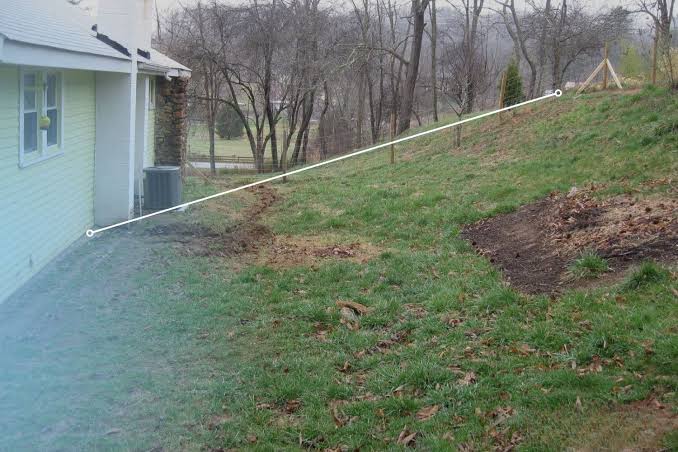
Water pushing toward the house, pooling against the foundation for more than 24 hours, or leaving a wet band parallel to the wall after a storm usually means the slope is wrong. Over 10 feet, you generally want the ground to drop about 6 inches away from the house, not climb back toward it.
Start with a rain check. Walk the yard during or right after a rainfall and look for three things: standing water, sheet flow, and erosion. Standing water means the ground is flat or depressed. Sheet flow means water is crossing the yard in a thin layer instead of entering a drain path. Erosion rills mean water is moving too fast in one channel and cutting the soil open.
Then check the area closest to the foundation. A slope that looks fine from the back fence can still fail in the first 3 to 5 feet near the house. If mulch, soil, or paving has built up against siding or the foundation line, the original grade may be buried. That can trap water at the wall even when the rest of the yard seems to drain.
A bad grade often shows up the same way again and again: one corner of the lawn stays spongy, one side of a walkway sinks, or a downspout dumps onto a low spot and the water never reaches the street. Same spot, same headache. That pattern matters. Random puddles after a rare storm suggest temporary overload. Repeated water in the same strip points to a shape problem.
The term positive drainage means the surface slopes away from the structure. If you can show that the first 10 feet do not shed water away from the house, grading work is usually at least part of the answer.
How do I check the slope and the wet spots?
Grab a string line, a 4-foot level, a shovel, and about 1 hour of daylight after the next rain. The point is not to measure every inch of the yard; it is to find where the water is getting trapped and whether the trap is in the surface grade or below it.
- Pick one wet area and mark it with stakes. Measure a 6- to 10-foot stretch from the foundation outward and note the low point. Verify that the low point stays in the same place after two different rain events. If it moves around, you may be seeing surface runoff from another part of the yard rather than a fixed grade issue.
- Measure the slope with a 4-foot level or a laser level. Place the tool on a straight board if needed and check the rise over run. Over 10 feet, a rough target is about 6 inches of fall away from the house. If the slope is flat or reverses toward the foundation, that is a grading problem.
- Dig a small test hole, about 6 to 8 inches deep, in the wet area. Look at the soil layers and moisture. Dense clay that stays sticky after 24 hours can hold water near the surface; sandy soil drains faster but may reveal a deeper water source if it still ponds. If the hole fills with water quickly and stays full, drainage below grade may be part of the issue.
- Watch the downspouts during rain or immediately after. Note where each one discharges and how far the water travels. A downspout that dumps within 3 feet of the house can overwhelm a good grade. If water escapes cleanly but the yard still floods elsewhere, the problem may be broader than roof runoff.
- Trace the path from the high ground to the low ground. Look for a swale, a shallow drainage channel that should guide water away. A swale that is too shallow, filled in, or reversed by landscaping can make water spread across the lawn. If the path is blocked by a walkway, driveway edge, or compacted soil, the water has nowhere to go.
- Check for a soil seam or hardpan layer. In a small test hole, see whether the topsoil gives way to a dense layer within the first 12 to 18 inches. Hardpan or compacted subsoil can act like a pan under the lawn. If water sits on that layer, surface regrading alone may not be enough.
- Look at the neighboring grade and the lot line. If water enters from a higher neighbor, from a driveway, or from a hill, your yard may be receiving runoff it cannot absorb. Verify whether the wetness starts at the uphill edge. If it does, a yard-only fix may fail unless the incoming water is redirected.
- Test after a full rain cycle, not just a drizzle. Recheck the area 12, 24, and 48 hours after rainfall. A puddle that disappears quickly is less concerning than soil that stays saturated for two days. If the ground remains soft long after the rain stops, you likely need more than a cosmetic topdressing.
A clean result looks like water moving off the surface within hours, no standing water near the foundation, and no spongy strip that returns after each storm. If your measurements show the slope is acceptable but the yard still stays wet, the problem may be subsurface drainage, soil compaction, or runoff from elsewhere. USGS is a useful reference on how soil moisture and infiltration vary.
Regrading or drainage: which one does the job?
Regrading is the better fit when the surface is wrong; drainage is the better fit when the surface is close to right but water still has no easy path out. If you need to choose, I would first ask whether water is sitting because of shape or because of volume.
Regrading changes the ground plane. It is the right tool when the yard slopes toward the house, a low spot sits where rain collects, or soil has settled after construction and now forms a basin. The result should be visible on a simple cross-section: the surface rises away from the foundation and feeds water into a lower area. This Old House has practical overviews of grading basics.
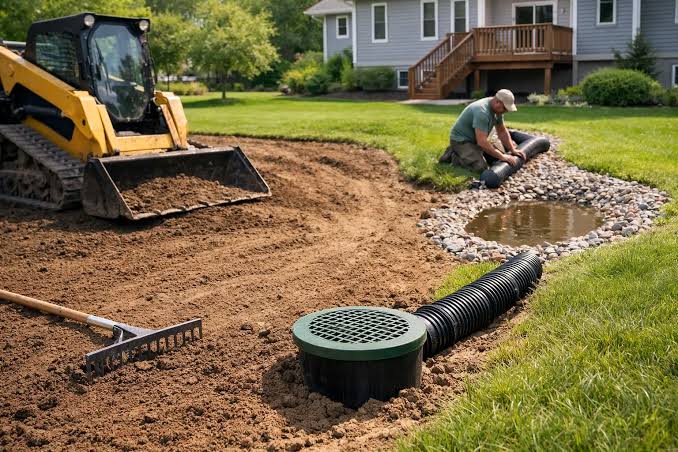
Drainage work handles situations where the land cannot be reshaped enough, or where water arrives from a place you cannot change. A French drain, for example, is a gravel-filled trench with perforated pipe that collects subsurface water. A catch basin gathers runoff from one point, such as a downspout or driveway edge, and sends it into pipe. A swale is a shallow open channel that moves water across the yard without the sharp trench of a drain. University of Minnesota Extension covers drainage options and runoff control.
The trade-off is pretty plain. Regrading is often cleaner at the surface, but it can be expensive in soil volume and can interfere with roots, patios, and walkways. Drainage work can solve problems that grading cannot, but it adds pipe, inlets, outlets, and maintenance points. A clogged inlet or crushed pipe can bring the problem back.
I would be skeptical of any plan that claims one shallow trench or one layer of topsoil will fix a yard with a buried clay bowl, uphill runoff, and downspouts dumping beside the house. That is the wrong tool for a compound problem.
When should you stop and get qualified help?
Stop and get qualified help when the water issue looks bigger than surface soil shape, or when changing the yard could affect the house, a retaining wall, or buried utilities. On this subject, waiting usually costs more than asking early. Really.
Water enters a basement, crawlspace, or garage: the issue is no longer just yard drainage — get a drainage or foundation specialist involved before changing grade near the structure.
The soil stays saturated for more than 48 hours after a normal rain: this can point to poor permeability, a high water table, or a blocked outlet — surface reshaping alone may fail.
There is a retaining wall, steep slope, or dropped yard elevation: the yard may depend on engineered drainage behind the wall — disturbing it can destabilize the wall.
Downspouts, sump discharge, or neighbor runoff all converge in one low spot: the water load may exceed what the yard can absorb — the solution usually needs a designed outlet.
Cracks, sinking pavers, or a leaning fence appear with the wet area: those are structural clues, not just lawn symptoms — do not guess at the cause.
You suspect buried utilities, septic components, or irrigation lines near the wet area: excavation can damage services — locate lines and consult the right pro first.
A good rule is this: if you can describe the problem entirely in terms of shallow soil and roof runoff, the job may be manageable. If you have to mention walls, structures, or water coming from outside the property, the problem belongs to someone who designs drainage systems for a living.
The mistakes that make the problem worse
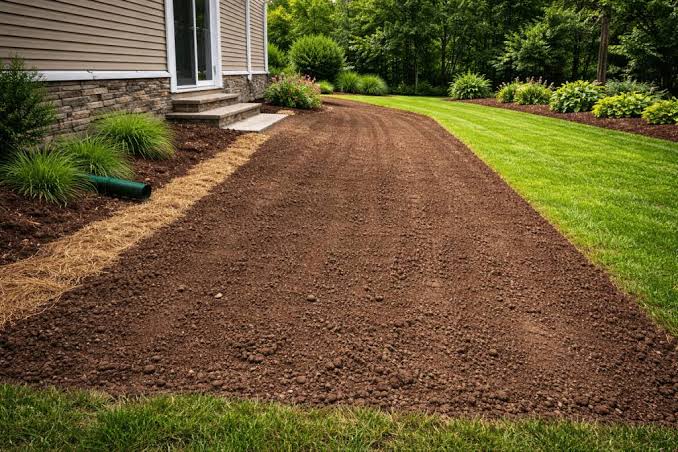
The most common mistake is adding soil to the wrong place, usually right next to the foundation. That can bury siding, trap moisture, and make the grade look better while the wall gets wetter. The correct move is to restore positive drainage without piling soil above the intended finish line.
Another mistake is installing drainage before fixing the slope. A French drain installed in a bowl-shaped yard can still be overwhelmed by surface water. The better sequence is to fix obvious grading errors first, then add drainage only where runoff still cannot escape.
A third mistake is treating one puddle as if it proves one cause. A lawn can puddle because of compacted soil, roof runoff, uphill water, or a settled low spot. If you skip the slope check and dig a trench anyway, you may solve nothing and create a maintenance job; if the cause is unclear, consult a drainage or foundation professional before excavating.
A fourth mistake is aiming all downspouts into the same discharge point. That can overload a small pipe or a low corner of the yard. The better alternative is to spread roof water out, use extensions where appropriate, and send it to a place that can accept it.
A fifth mistake is ignoring what happens after the first 24 hours. A yard that sheds surface water but remains soggy beneath can still damage roots and keep the ground unstable. The right test is not “Did the puddle vanish?” but “Did the soil return to normal firmness within 1 to 2 days?”
A sixth mistake is cutting a steep swale that erodes every storm. A swale should move water gently, not create a ditch. If the channel scours, it needs a flatter profile, rock protection, or a different outlet. Short and simple. Better.
What changes when the yard is not a simple rectangle?
The standard advice changes when the yard has a slope, clay soil, trees, patios, or a tight lot line. In those cases, the goal is not just “make it drain” but “make it drain without causing a new problem.”
On a sloped lot, water may arrive with enough force to cut channels. A shallow swale can help, but it may need rock lining, check dams, or a catch basin at the low point. On heavy clay, the surface can look dry while the subsoil stays wet, so the issue may be infiltration rather than visible pooling. In that case, regrading alone can still leave the yard mushy.
Tree roots change the equation because they hate deep excavation. A 12-inch trench near mature roots can damage trees and still not cure a grade issue; if the problem is close to established trees, consult an arborist or landscape professional before digging. Patios and driveways are another limit: if hard surfaces block the flow path, you may need a drain inlet or a channel drain to carry water under or around them. A channel drain is the narrow grate you see along concrete edges; it collects surface water fast, but it needs a clear outlet and regular cleaning.
Small urban lots have their own problem: there may be nowhere legal or practical to dump water. That is when local rules, setbacks, and outlet location matter. I would not assume a dry well, French drain, or splash block is acceptable just because it is common. Local conditions decide.
The biggest edge case is the high water table. If the ground water is close to the surface, you can improve surface drainage, but you may not be able to create a permanently dry lawn. That is not a failure of effort; it is a site limit.