Last updated: September 10, 2026
Key Takeaways
- Verify: the full run stays open, right through the last 3 to 6 feet.
- Small patios may only need better slope away from the house, usually around 2% or 1/4 inch per foot for hardscape grading, though local standards vary.
- I am not treating every drainage problem as a DIY job; if water is entering a foundation, a retaining wall is moving, or sewage is involved, consult a qualified drainage contractor, civil engineer, plumber, or building professional, depending on the source.
- With no outlet, a drain system turns into storage. Not a solution.
Drainage system options fall into two broad jobs: move surface water away from a property, or move groundwater and wastewater where it belongs. This drainage system options — complete guide focuses on the practical question most readers actually have: which drainage system fits this site, and what are the trade-offs? The right choice depends on the soil, the slope, the source of the water, and what failure you are trying to prevent.
What this guide applies to
Homeowners, builders, and property managers are the audience here. Pooling in a yard? Water creeping into a basement or crawlspace? Runoff around a driveway or patio? Or ground that stays soggy after rain? This guide applies to those problems. Drainage system options — complete guide assumes you already know the basic difference between rainwater and sewage, and that you can identify the problem area well enough to describe where the water appears, how long it stays, and whether it is coming from a roof, a hard surface, or the ground itself.
I am not treating every drainage problem as a DIY job. A foundation wall that is taking on water, a moving retaining wall, a septic system in the mix, or foul water / contaminated runoff / repeat failure after a previous repair — that is site-specific work, not guesswork. In those cases, do not pick between trench drain, French drain, or sump pump by feel. Have the system assessed by a qualified drainage contractor, civil engineer, plumber, or building professional, depending on the source of the water.
For ordinary yard and roof-water problems, though, the main drainage system options are predictable. A surface swale, a catch basin with pipe, a French drain, a downspout line, a dry well, a channel drain, or a sump system each solves a different problem. People often ask which one is “best.” Wrong question. Better to ask whether you need to intercept water before it soaks in, collect it after it arrives, or pump it once gravity gives up. A drainage system that works on a sandy lot with a 2% slope can fail completely in heavy clay or in a flat yard with no legal discharge point.
If you want a single summary before the detail: use surface drainage first, subsurface drainage second, and pumping only when gravity cannot do the job. That order matters because it is cheaper, simpler, and less likely to fail hidden underground.
What are the main drainage system options?
The main drainage system options are surface grading, swales, gutters and downspout extensions, trench drains, catch basins, French drains, dry wells, sump pumps, and stormwater piping to an approved outlet. Each one handles a different part of the water path, and the wrong one is usually expensive because it fixes the symptom instead of the source.
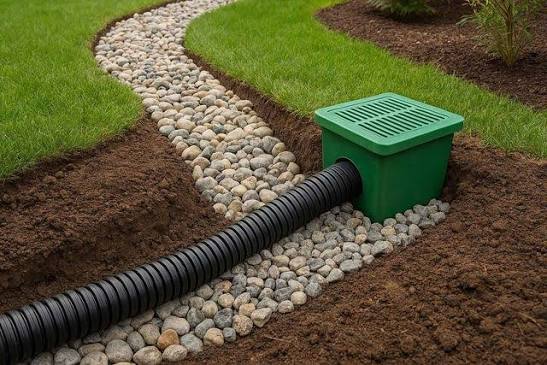
A swale is a shallow, grassed ditch shaped to guide water along a controlled path. A French drain is a gravel trench with perforated pipe that collects subsurface water and moves it away. A catch basin is a box with an inlet grate that traps water at a low point and sends it into pipe. A trench drain is a linear grate drain used where water sheets across a hard surface. A dry well is an underground storage pit that lets water soak into the surrounding soil. A sump pump collects water in a pit and pumps it elsewhere.
Here is how I would think about the main drainage system options:
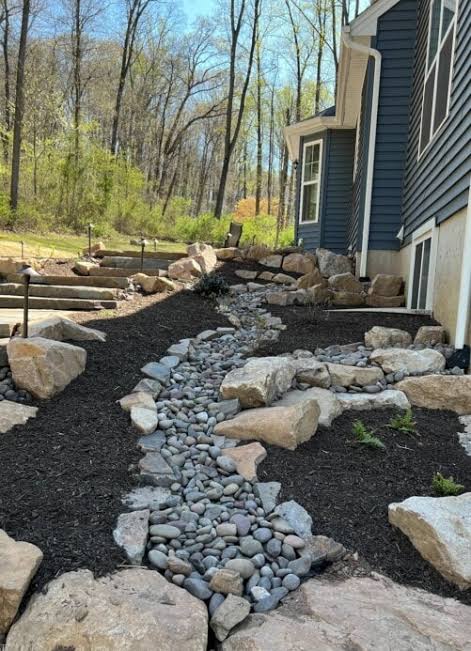
- Regrading and swales: best when the ground can still be shaped and the goal is simply to keep water from sitting near the house.
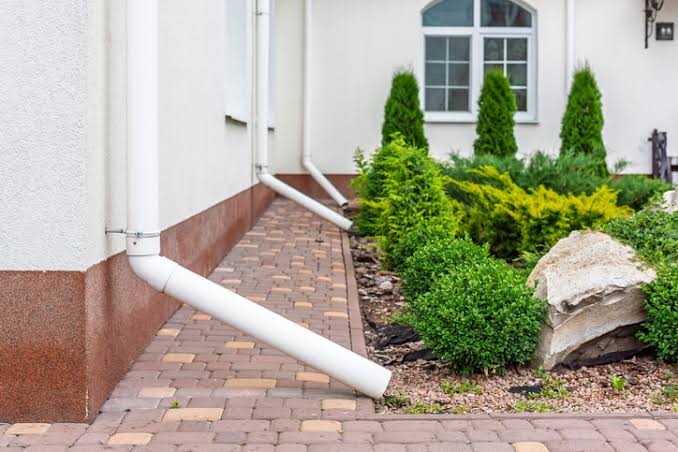
- Downspout extensions: best when roof runoff is the real problem. This is often the least expensive first fix, and it is usually worth doing before anything underground.
- French drains: best for groundwater seepage, saturated soil, or water collecting along the side of a foundation or retaining wall.
- Catch basins and piped storm drains: best for yards, driveways, or low spots where surface water concentrates.
- Trench drains: best for patios, garage aprons, or driveways where water crosses a hard edge and needs to be intercepted quickly.
- Dry wells: best only where the soil infiltrates well and local rules allow infiltration.
- Sump systems: best when a basement or crawlspace sits below the drainable outlet level.
Here is the trade-off, plain and simple: surface systems are easier to inspect and maintain, but they can be visible; buried systems look cleaner, but they are harder to repair once they clog. Thorny little truth. That is why a good design often combines two or three methods instead of relying on one underground pipe to solve everything.
A plain English example: if your yard floods because a roof dumps 600 square feet of runoff into one corner, the first fix is usually to extend the downspout 6 to 10 feet away, then shape the grade so water keeps moving, then add a drain only if the soil still stays wet. Start with a French drain instead, and you may spend more while leaving the roof water source untouched.
How do I choose the right drainage system?
Match the water source, the soil, the slope, and the discharge point before you pick the hardware. That order matters more than brand names, pipe diameter, or gravel type.
Start with the source. Roof runoff behaves differently from water that rises out of the ground. Roof water arrives in bursts; gutters, downspouts, and a trench drain can catch it. Groundwater seepage is slower and usually needs a French drain or sump pit. Surface runoff from a slope can often be fixed with grading or a swale. Water trapped on a driveway or patio usually needs a trench drain or catch basin.
Now look at the soil. Sandy and loamy soils drain more freely than dense clay. That does not mean clay is impossible to work with, only that dry wells and infiltration trenches are less forgiving. If the soil holds water for hours or days after rain, I would be cautious about relying on anything that depends on percolation, which is the downward movement of water through soil. In that case, moving water to an outlet is usually more reliable than trying to soak it away in place.
Then check slope. Gravity drainage needs fall. A common planning target for pipe and surface flow is roughly 1% slope, or about 1/8 inch per foot, though exact requirements depend on the system and local code. No slope? No magic. If you do not have enough fall from the problem area to a legal discharge point, a sump pump may be the only practical option, but the final design still needs to be checked against the site and local requirements.
Finally, look at the outlet. Water has to go somewhere. That can mean the street storm drain where allowed, a daylight outlet downhill, a dry well, or a sump discharge routed away from the foundation. If there is no outlet, any drain system becomes a storage problem instead of a drainage solution.
I would sort the choices this way:
- Fix grading first if the issue is shallow pooling near the surface.
- Extend downspouts if roof runoff is concentrated near the problem area.
- Add a surface interceptor like a trench drain or catch basin if water reaches a hard edge or low point.
- Use a French drain if water is coming through or along the soil.
- Use a sump system if the water level is below the outlet level and gravity cannot move it.
- Use a dry well only if infiltration is actually suitable and local rules allow it.
A fully buried setup can look elegant on paper. But a visible swale or a longer downspout extension may solve the same problem with less risk and less maintenance. I usually prefer the boring fix when it works.
How do you install a basic drainage layout step by step?
Trace the water path, set the slope, choose the collection point, and build the system so every segment moves water downhill or into a pump pit. The details vary by option, but the sequence does not.
- Mark the problem area and the water source. Walk the site after rain or look for stain lines, sediment trails, or moss growth, then mark the low spot and the path water follows with flags or paint. Measure the distance from the source to the outlet point in feet. Verify: you can point to the exact origin and the exact exit. Problem sign: if the water source is still vague, you are not ready to design the drain.
- Check available fall with a level or laser. Measure the height difference over the planned route and target about 1% slope for drain pipe, which is roughly 1/8 inch per foot, unless the manufacturer or local code calls for something else. Verify: the line drops continuously with no backfall. Problem sign: any flat section, hump, or reverse slope will trap sediment and water.
- Choose the system type based on the source. Use a swale for broad sheet flow, a trench drain for hard surfaces, a catch basin for a low point, a French drain for subsurface seepage, or a sump for below-grade collection. Verify: the chosen system matches the water source, not just the look of the site. Problem sign: if you are planning a French drain to fix roof runoff, you are probably solving the wrong problem.
- Lay out the discharge path before you dig. Decide where water will go for the full length of the system: daylight outlet, storm connection where legal, dry well, or sump discharge. Keep discharge lines away from foundations and areas that flood back. Verify: the path stays clear for the full run, including the last 3 to 6 feet. Problem sign: if you cannot name the outlet, the system will fail as a storage trench.
- Excavate only after the layout and fall are confirmed. For a French drain, the trench is often wide enough to hold pipe and gravel, with enough cover to protect it from surface loading. For a trench drain, the channel body must sit flush with the finished surface. Verify: the trench follows the planned grade and the parts fit without forcing. Problem sign: irregular depth creates dead spots and weak cover.
- Install geotextile fabric where the design calls for it. Use a nonwoven geotextile to separate soil from gravel in many French drain and dry well assemblies. Fold it so the material can close over the top. Verify: soil cannot migrate directly into the drainage stone. Problem sign: bare stone in silty or clay soil will clog faster.
- Place pipe, basin, or drain body with the inlet at the right elevation. Perforated pipe in a French drain is usually set with the holes oriented per the manufacturer’s instructions; solid pipe is used to carry water away from the collection point. Use 4-inch pipe where the flow volume is modest; larger runs may require more capacity, which should be checked rather than guessed. Verify: every joint is seated and the pipe line continues the planned slope. Problem sign: bellies, loose couplings, or crushed pipe will hold sediment and slow flow.
- Backfill, compact, and test with water. Place gravel in lifts where required, compact soil around the trench, and run water from a hose or downspout for at least several minutes to confirm flow. Verify: water reaches the outlet without backing up at the inlet. Problem sign: standing water in the basin, slow clearing, or wet spots along the trench line show a grade or blockage issue.
The job is not finished when the trench is covered. A drainage system is only as good as its least accessible joint. Cleanouts matter. A cleanout is an access point that lets you flush or snake the line later. I would add one wherever the run turns sharply or extends a long distance, especially if the drainage system options being used depend on hidden pipe.
One practical rule: if the system includes more than one buried transition, I would test it before final backfill and again after the first major rain. A line that “looks good” is not the same thing as a line that carries water without backing up.
Which drainage option works best for a basement, yard, driveway, or patio?
The best drainage option depends on whether the problem is below grade, on grade, or on a hard surface. That distinction matters because the water path changes with each one.
For a basement, I would start by asking whether water is entering at the wall, the floor joint, or through a window well. If it is wall seepage or floor leakage, a French drain tied to a sump pit is often the practical solution, because the water is already underground and gravity drainage may not be enough. Interior drain tile, a term used for a perimeter drain installed at the slab edge, is common in basement waterproofing, but it is not a casual DIY fix. If the issue is only a poorly directed downspout outside, fix that first. A basement wall problem is the wrong place to start if a 10-foot downspout extension would stop the load.
For a yard, the usual answer is surface correction first: grading, a swale, or a catch basin. A yard that stays soft after rain often needs the soil reshaped so water does not sit in a shallow bowl. If the yard is low because of compaction or repeated settling, a French drain can help, but only if there is somewhere for the water to go. In a clay-heavy yard, I would be careful about dry wells; they are often oversold as a universal fix.
For a driveway, a trench drain is often the cleanest answer when water sheets across the pavement or flows toward a garage. A channel drain at the apron can intercept water before it enters the building. For a long driveway on slope, a cross-drain or catch basin may be better than trying to edge-drain the entire length. The key requirement is a drain body set flush with the finished surface and sized for expected runoff. A driveway drain that sits proud of the surface becomes a trip hazard and catches debris.
For a patio, the right choice is usually the least intrusive one that prevents ponding. Small patios may only need better slope away from the house, usually around 2% or 1/4 inch per foot for hardscape grading, though local standards vary. If the patio is bounded by walls or has no room to regrade, a trench drain or narrow slot drain can intercept water. If you can run a shallow swale beside the patio, I would choose that before burying pipe under finished paving.
The main mistake is to assign the same drain to every setting. A basement needs a collection-and-removal system. A yard often needs a shaping problem solved. A driveway needs a surface interceptor. A patio may only need a better fall line.
When should I stop and choose a different approach?
You should stop and choose a different approach when gravity drainage becomes unreliable, when the water is not clean stormwater, or when the system would depend on soil that cannot absorb it. These are the cases where forcing the standard answer usually creates a bigger repair later.
Water keeps returning after a previous drain was installed: the outlet may be blocked, undersized, or set at the wrong elevation — do not add another blind trench until the original system is inspected and flushed.
The area is near a foundation crack, bowed wall, or sinking slab: the problem may be structural as much as hydraulic — get the wall or slab evaluated before relying on a drain alone.
The soil is heavy clay and stays saturated for more than a day after rain: infiltration-based fixes such as dry wells and some French drains will be slow or ineffective — use surface redirection or a pumped outlet instead.
There is no legal or reliable discharge point within the available slope: gravity drainage cannot complete the job — a sump pump or a redesign of the discharge route is the realistic option.
The water contains sewage, graywater, or chemical contamination: this is not a standard yard drainage problem — stop and use the proper plumbing, septic, or environmental route.
A retaining wall, slope, or embankment is moving: water may be contributing to slope failure — drainage alone will not stabilize it, and wrong excavation can make the failure worse.
The system would pass under a driveway, tree root zone, or other obstruction without access: repairs will be difficult and costly — reroute the line or add cleanouts before closing the trench.
If the answer to any of those is “yes,” the problem is no longer just “which drain?” It becomes “what is actually causing the failure?” Different question. Different tool.
What mistakes do people actually make with drainage systems?
The most common mistakes are choosing the wrong drainage system options for the water source, ignoring slope, using the wrong outlet, and burying a system that cannot be maintained. Those errors are expensive because drainage failures often stay hidden until the next storm.
-
Using a French drain for roof runoff. The consequence is a trench that receives far more concentrated flow than it was meant to handle, so it clogs or saturates the soil. The better alternative is to extend the downspout and use surface grading first, then add a collection drain only if needed.
-
Setting pipe with no consistent fall. The consequence is standing water, sediment buildup, and eventual blockage. The better alternative is to check grade every few feet with a level or laser and keep the line continuous.
-
Relying on a dry well in poor soil. The consequence is a pit that fills and stays full after modest rain. The better alternative is a daylight outlet, storm connection where legal, or a pumped outlet where gravity cannot help.
-
Using a catch basin or trench drain with no maintenance access. The consequence is a unit that fills with grit, leaves, and debris, then behaves like a plugged sink. The better alternative is to