Last updated: September 10, 2026
Key Takeaways
- Place fill in thin lifts of about 2 to 4 inches.
- Drive stakes 10 to 20 feet apart, run a taut string, and measure down to the soil every 2 to 4 feet.
- Mark every point that sits lower than the desired plane, using stakes or marking paint over at least 10 feet from the structure.
- Regrading is the right tool when the site’s surface pitch is wrong.
Table of Contents
- Who this applies to — and what you need to know first
- Is regrading better than adding a French drain?
- How do I tell whether the yard itself is the problem?
- What should I do first if I decide to regrade?
- When should I stop and use drainage instead?
- The mistakes people make when they choose the wrong fix
- What does a good result look like after regrading?
A yard that keeps holding water is usually telling you something simple: the ground is pointing it the wrong way. That is the blunt answer to when to regrade a yard instead of adding more drainage. Drainage pipes, French drains, and catch basins can carry water once it is already there, but they cannot fix a surface that slopes toward the house, a patio, or a dead-end low spot. Unsure? Call a drainage professional or site contractor. A 2020 USDA NRCS technical note on landscape drainage and grading emphasizes that positive surface slope is the first line of defense, and ASTM E2947 also treats site water management as a grading-plus-drainage question, not a pipe-only question.
Who this applies to — and what you need to know first
This is for a homeowner or property manager looking at standing water, soggy turf, runoff toward a foundation, or a yard that stays soft for hours after ordinary rain. That’s the situation. I’m assuming the issue is not just one broken downspout, and that you can tell a short post-storm puddle from a yard that stays wet for most of a day. Basic layout work matters too: a 4-foot level, a string line, stakes, and a tape measure.
Regrading is the right tool when the site’s surface pitch is wrong. “Grade” means the contour of the soil surface; “positive slope” means water moves away from structures. If the finish grade falls toward the house for more than a short distance, no amount of added drainage will fully compensate. I’d fix that first. Honestly, that’s the whole point of when to regrade a yard instead of adding more drainage.
Not every wet yard is a grading job. A high groundwater table, a spring, or water entering from a neighbor’s property changes the picture fast. So does a finished basement with active seepage, visible foundation movement, or a retaining wall issue. In those situations, the yard is only one piece, and a foundation or drainage professional should look at it before you change the grade.
Here’s the rule I’d use: if the surface can be shaped so water leaves on its own, do that before burying pipe. Pipe collects and carries water. Grade prevents it from arriving in the first place. On a typical residential lot, that difference matters more than the brand name on the drain, and it is why when to regrade a yard instead of adding more drainage is often the cheaper first question. Cheap can be the wrong word; usually cheaper is safer.
Is regrading better than adding a French drain?
Choose regrading when the slope itself is the problem. Choose a French drain when the yard already pitches the right way but water still gathers in one strip or pocket. A French drain is a trench with perforated pipe, washed stone, and a filter layer that intercepts water below or near the surface. It works well along a foundation, beside a driveway, or at the bottom of a slope. It is not a substitute for a yard that drains the wrong direction over a broad area.
I would pick regrading if I saw water running toward the house for more than the first 5 to 10 feet from the foundation; a patio or walk that has settled and holds water; a lawn with a broad saucer shape; or downspouts dumping onto a surface that cannot carry the water away. In those cases, when to regrade a yard instead of adding more drainage is answered by the geometry, plain and simple. No magic. Just slope.
Added drainage makes more sense when the yard already slopes away correctly, but the soil is slow-draining clay, the water appears after heavy rain and lingers in one defined spot, or the wet area is too small to justify moving a lot of soil. A pipe or basin can handle a concentrated problem without tearing up the whole yard.
The trade-off is straightforward. Regrading changes the surface and can affect turf, irrigation heads, sidewalks, mulch beds, and fence lines. It may also mean hauling in fill and dealing with access. Drainage is often less visible and sometimes less disruptive, but it depends on gravity, outlets, and regular maintenance. If there is nowhere for the pipe to empty, or the outlet would be too close to the problem, the drain solves less than it promises. According to the EPA’s stormwater guidance, even small residential runoff changes can matter when they concentrate flow.
One practical clue: if you cannot explain where the water will go after a drain is installed, the project is probably underdesigned. If you can explain where the water will go after regrading, that is usually the cleaner answer. Cleaner, yes. Also less fussy.
How do I tell whether the yard itself is the problem?
Check slope, water path, and the shape of the wet area. Not the puddle alone. A 4-foot level is the simplest tool, though a laser level gives cleaner readings across a larger yard. For a typical residential setup, a drop of about 1/4 inch per foot away from a structure for the first several feet is a practical minimum for positive slope; many foundation and drainage references use that figure. After that, the exact pitch can vary with site conditions, and local code or site design can call for more.
Start at the house, slab, patio, or retaining wall. Look for settled edges, eroded mulch, or splashback stains. Then check whether water marks point away from the structure or into it. A yard that should fall away but actually dips back toward the house often needs grading correction before anything else, especially when to regrade a yard instead of adding more drainage is the real question.
The wet area shape tells you a lot. A narrow strip of saturation along one edge often suggests a drainable line problem. A broad bowl-shaped wet area suggests bad grading. If the same spot stays wet after a day of dry weather, suspect compacted soil, a depression, or a perched water table. If the issue appears only during heavy storms and the rest of the yard dries quickly, drainage may be enough.
Try a string-line test. Drive stakes 10 to 20 feet apart, run a taut string, and measure down to the soil every 2 to 4 feet. You want a consistent fall, not a jagged set of dips. Even 1 inch over a short run can make a basin. If the yard drops toward the structure at any point, that is a strong sign to regrade.
Also check the property line. If water is arriving from uphill, or if the neighbor’s lot sheds into yours, a surface drain alone may collect water you still need to redirect with slope changes. Measure the ground before buying pipe. Pipe is easy to overestimate; geometry is harder to argue with. It wins every time.
What should I do first if I decide to regrade?
Strip the problem area, shape the subgrade, and restore a continuous fall away from the trouble spot in controlled lifts. Do not dump soil on top and hope for the best. The goal is a surface that sheds water by itself, with any added drainage treated as support, not the main fix.
- Map the low spots with a level or laser level. Mark every point that sits lower than the desired plane, using stakes or marking paint over at least 10 feet from the structure. Verify the slope line is readable from end to end. A problem shows up if the yard changes direction multiple times instead of having one clear fall.
- Set the target pitch. For the first 5 to 10 feet from a house, aim for about 1/4 inch per foot away from the structure unless the site requires a different engineered condition. Verify the finished surface will not create a step at doors, walkways, or siding. A problem shows up if the target grade would bury siding, trap water against a slab, or create a trip hazard.
- Remove turf and debris from the work zone. Strip sod, roots, and loose organic matter from the area you plan to raise or cut. Verify you are down to firm soil, not soft thatch. A problem shows up if you build grade on top of organic material, which settles later and recreates the dip.
- Cut high spots before you add fill. Move soil from the high side to the low side where possible. Verify the low area is becoming a continuous plane, not a mound with a moat around it. A problem shows up if you keep adding soil and lose control of the slope.
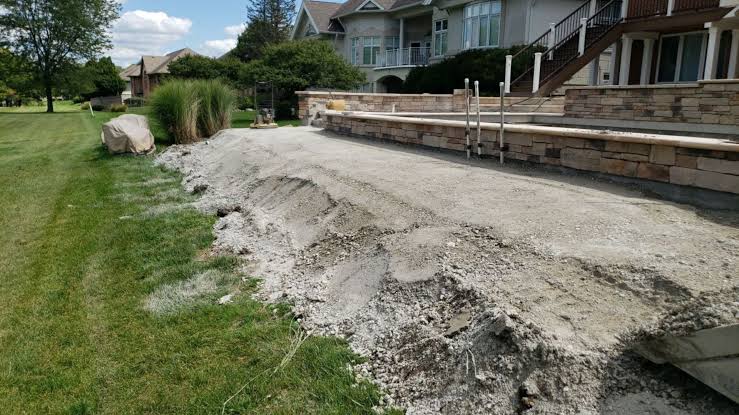
- Place fill in thin lifts of about 2 to 4 inches. Compact each lift before adding the next. Verify the fill does not pump underfoot and does not leave a soft, spongy feel. A problem shows up if the surface settles immediately or the fill shifts when you walk on it.
- Blend the grade into surrounding areas. Feather the new slope into the existing lawn, driveway edge, or bed line over several feet. Verify water will not be trapped in a sharp ridge. A problem shows up if you create a dam or make one new low spot while fixing another.
- Restore surface drainage paths. Shape swales, shallow channels, or subtle crowns so water has a visible escape route. Verify the path leads to a legal and functional outlet, such as the front yard, a street where allowed, or an approved storm connection. A problem shows up if the new route sends water toward a neighbor, a basement window, or a walkway.
- Test with a hose in 10- to 15-minute intervals. Run water to see whether it sheets off or collects. Verify there is no standing water after the surface has had time to drain. A problem shows up if water still finds the same pocket, which means the grade is not finished or the outlet is inadequate.
If the work area is large, I’d break it into sections instead of trying to shape the whole yard at once. That keeps the corrections visible. Regrading is not glamorous, but good grading is obvious when rain falls: water moves, and the yard does not argue back. According to the NRCS, thin-lift placement and compaction are the difference between a temporary fix and a stable finish.
When should I stop and use drainage instead?
Stop regrading and switch to drainage when the problem cannot be solved by changing the surface without creating a new issue elsewhere. That happens on tight lots, beside foundations, or where the yard has too little fall to move water naturally.
The lot is nearly flat over 30 feet or more: There is not enough natural drop to carry water away by grade alone — use surface drainage, subsurface drainage, or an engineered plan.
The wet area is a long, narrow strip rather than a bowl: That usually points to a flow line or a shallow seep line — a French drain or swale may work better than reshaping the whole yard.
Adding fill would bury siding, vents, or door thresholds: That creates moisture and entry problems — stop and redesign the site instead of raising the grade blindly.
Water is coming from uphill outside your property: The source is not your yard alone — direct the inflow first, then decide whether any grading still helps.
You see foundation cracks, differential settlement, or a wall that moves: The issue is beyond landscape grading — get a qualified foundation assessment before you move more soil.
The only discharge route would send water onto a neighbor’s lot or into a prohibited area: That is not a usable solution — use a designed drainage path that meets local rules.
In practical terms, if regrading would mean moving so much soil that you’re basically redesigning the site, the project has crossed into drainage design. At that point, I would treat grading as one part of the fix, not the fix itself, and I would consult a professional if foundation or outlet issues are part of the picture. Drainage becomes the better choice when you need control, not just slope. Sometimes the shovel just loses the fight.
The mistakes people make when they choose the wrong fix
The first mistake is adding more pipe before checking slope. That wastes money and time because a drain still needs a place to discharge. The better alternative is to establish the final surface pitch first, then decide whether a drain is still needed.
The second mistake is filling a low spot with loose soil and calling it done. Loose fill settles, often within one season, and the puddle comes back. The correct alternative is to place compacted fill in thin lifts and verify the slope after compaction.
The third mistake is creating a steep lip at the edge of the repair. That traps runoff in the wrong place and can make mowing harder. The correct alternative is to feather the grade over several feet so water transitions cleanly.
The fourth mistake is ignoring downspouts and roof runoff. A 2-inch roof storm can dump a surprising volume of water onto one corner of the yard; if that water still lands in the same depression, no soil correction will hold up. The alternative is to extend downspouts or tie their discharge into the corrected surface plan.
The fifth mistake is regrading around a hidden structural issue. If a slab has sunk or a wall is already compromised, changing the yard grade hides the symptom. The correct alternative is to address the structure first and use grading only after the underlying movement is understood.
The sixth mistake is overcorrecting and sending water to the wrong place. A yard can go from one bad low spot to another if the new slope aims at a patio, driveway seam, or basement window well. The better alternative is to trace the water path all the way to its outlet before you move the first shovel of soil.
A good rule: if the repair creates a new puddle, it is not finished. It is just relocated. For when to regrade a yard instead of adding more drainage, that is the clearest warning sign.
What does a good result look like after regrading?
A good result looks boring in the best way: water moves off the problem area within minutes of a normal rain, the soil surface does not hold footprints for long, and the yard maintains one clear, readable slope. You should not see a shiny low spot, a narrow trench of runoff cutting through the lawn, or water collecting near a slab edge.
In a typical yard, the finished surface should feel firm underfoot after compaction, with no spongy rebound in the repaired area. If you used fill, the area should be stable enough that minor settling is not turning into a basin. A correctly shaped grade often makes mowing easier too, because the lawn no longer has soft depressions that bog down a mower.
I also look for what is not happening. Water should not be staining the foundation, pooling against edging, or standing at the base of a stair. If you corrected the grade and the same puddle returns after a hose test, the finish shape is wrong or the site has a separate drainage source.
For a small repair, the whole job may take a single weekend if the soil is workable and access is easy. Larger yards take longer because the slope has to be blended, not just patched. If the work requires bringing in substantial fill or changing several features at once, when to regrade a yard instead of adding more drainage may still be the right question, but the answer is more likely to involve a site plan than a quick fix.